

If-Clauses Englisch: Typ 1, 2 und 3 erklärt
Mit If-Sätzen sagst du, was unter einer Bedingung passiert. Du lernst Typ 1, 2 und 3 mit den passenden Zeitformen.
Kurz gesagt
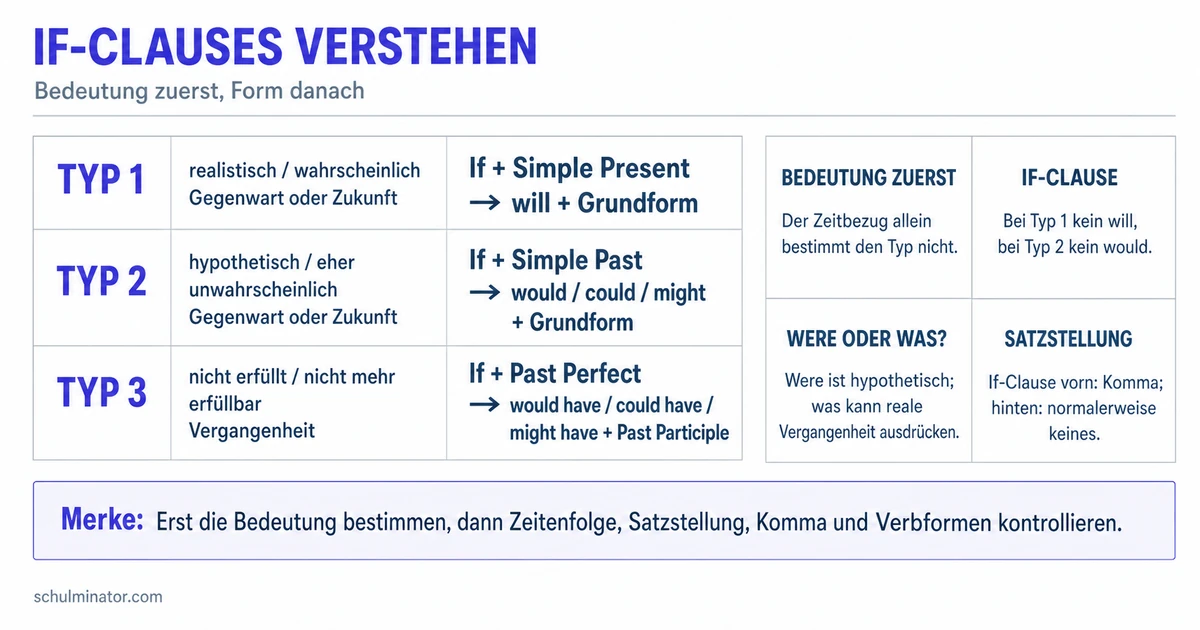
If-Sätze (conditional sentences) nennen eine Bedingung und ihre Folge. Typ 1, real möglich: „if“ + Simple Present, „will“ + Grundform. Typ 2, nur vorgestellt: „if“ + Simple Past, „would“ + Grundform. Typ 3, vorbei: „if“ + Past Perfect, „would have“ + Past Participle.
„If it rains, we'll stay at home.“ Mit solchen Sätzen planst du, träumst oder ärgerst dich über etwas Verpasstes. Welcher Typ passt, hängt davon ab, wie wahrscheinlich die Bedingung ist.
Deine Lernziele
Ein If-Satz hat zwei Teile: den if-clause mit der Bedingung und den Hauptsatz mit der Folge. „if“ heißt dabei „wenn“ oder „falls“. Bevor du ihn bildest, fragst du: Ist die Bedingung real möglich, nur vorgestellt oder schon vorbei? Daraus ergibt sich der Typ.
If-Satz (conditional sentence)
Satz aus if-clause (Bedingung) und main clause (Folge): „If it rains, I will stay at home.“
| Typ | Bedeutung | if-clause | main clause |
|---|---|---|---|
| Typ 1 | real möglich | Simple Present | „will“ + Grundform |
| Typ 2 | unwahrscheinlich oder nur vorgestellt | Simple Past | „would“ + Grundform |
| Typ 3 | Vergangenheit, nicht mehr änderbar | Past Perfect | „would have“ + Past Participle |
Teste dich
Typ 1 benutzt du, wenn die Bedingung gut eintreten kann. Im if-clause steht das Simple Present, im Hauptsatz „will“ + Grundform. Statt „will“ gehen auch „can“, „might“, „must“ oder ein Imperativ.
Beispiel: Typ 1 bauen
- 1Bedingung (Simple Present): „If you hurry,“
- 2Folge („will“ + Grundform): „you will catch the bus.“
- 3Mit Imperativ: „If you see Nina, tell her about the plan.“
Merke: Kein „will“ im if-clause – auch wenn es um die Zukunft geht: „If it rains tomorrow, we will stay inside.“
Teste dich
Typ 2 benutzt du für Träume und unwahrscheinliche Situationen in der Gegenwart oder Zukunft. Im if-clause steht das Simple Past, im Hauptsatz „would“ (oder „could“, „might“) + Grundform. Die Past-Form zeigt hier keine Vergangenheit, sondern Abstand zur Wirklichkeit.
Beispiel: Typ 2 bauen
- 1Bedingung (Simple Past): „If I won the lottery,“
- 2Folge („would“ + Grundform): „I would travel around the world.“
- 3Ratschlag: „If I were you, I would take the chance.“
Merke: Bei „be“ steht im Typ 2 oft „were“ für alle Personen: „If I were you, …“ In der Alltagssprache hörst du auch „was“.
Teste dich
Mit Typ 3 sprichst du über die Vergangenheit, die sich nicht mehr ändern lässt – oft, wenn du etwas bereust. Im if-clause steht das Past Perfect, im Hauptsatz „would have“ (oder „could have“, „might have“) + Past Participle. Das Past Participle ist die dritte Verbform und nicht immer gleich der Past-Form: „know – knew – known“. Beide Satzteile kannst du tauschen, der Typ bleibt gleich.
Beispiel: Typ 3 bauen
- 1Bedingung („had“ + Past Participle): „If we had left earlier,“
- 2Folge („would have“ + Past Participle): „we would have caught the train.“
Merke: Komma: Steht der if-clause vorne, setzt du ein Komma. Steht er hinten, normalerweise nicht: „We would have caught the train if we had left earlier.“
Teste dich
Alles auf einen Blick
If-Sätze
Bedingung mit „if“ + Folge
real möglich, Present + „will“
vorgestellt, Past + „would“
vorbei, Past Perfect + „would have“
nur wenn if-clause vorne steht
kein „will“ oder „would“ im if-clause
Eine Situation in alle drei Typen setzen
- 1Situation: Lena übt Klavier für ein Konzert.
- 2Typ 1 (gut möglich): „If Lena practises, she will improve.“
- 3Typ 2 (nur vorgestellt): „If Lena practised more, she would improve faster.“
- 4Typ 3 (vorbei): „If Lena had practised, she would have played better at the concert.“
- 5Check: kein „will“ oder „would“ im if-clause, Komma nach dem vorangestellten if-clause.
Fehler finden
Fehler in Zeile 3Im if-clause von Typ 1 steht kein „will“, sondern das Simple Present. Richtig: „If it rains, we will stay at home.“
Lückentext
Im if-clause von Typ 1 steht das . Typ 2 bildest du mit Simple Past und + Grundform. Steht der if-clause vorne, setzt du .